
TRAFOLO takes a different approach compared to tools like ANSYS Maxwell, COMSOL Multiphysics, RALE, OpenMagnetics, Frenetic, or Excel spreadsheets.
Consider a typical three-step R&D process – design, verification, and optimization. There is a clear distinction between the different phases.
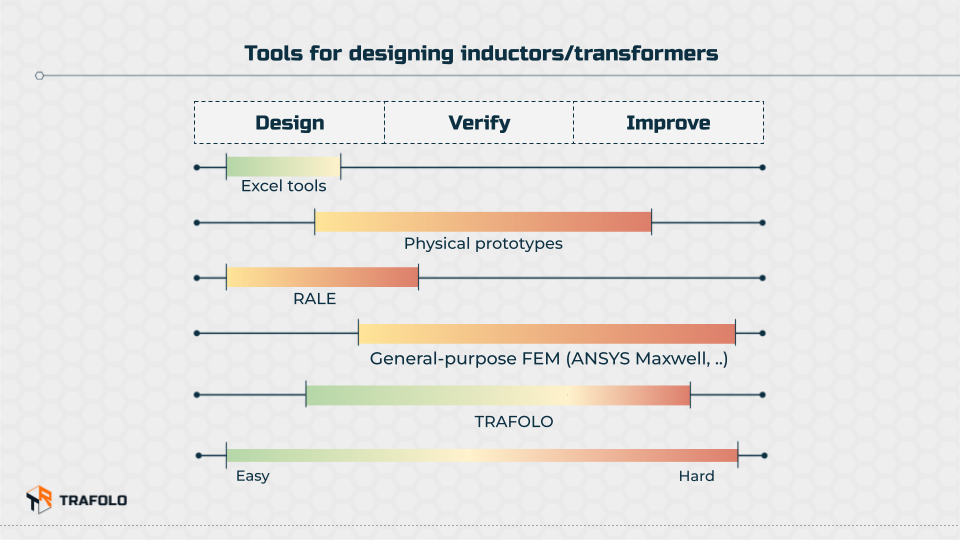
Comparison between TRAFOLO, ANSYS Maxwell, RALE, and other design tools. Colors indicate the (subjective) difficulty of use, while the length and position of the blocks show where each method is most applicable.
In the design phase, a concept is developed, including the choice of winding and core. A wide parameter space must be explored to find globally optimal solutions in terms of size, cost, and efficiency. This is typically handled by equation-based tools (with or without claimed AI features) such as OpenMagnetics and Frenetic. However, due to high computational cost, 3D FEM tools are rarely used at this stage.
In the verification phase, one or a few candidate designs are evaluated. Physical or virtual prototypes are created and tested. Here, FEM simulations help reduce the number of physical prototypes and validate results from design tools, or similar approaches, against initial specifications.
In the improvement phase, the design is refined iteratively. FEM simulations provide insight into quantities that are difficult to measure or observe directly, such as magnetic flux distribution, local losses, and hotspots. As a result, they are widely used as a hypothesis-testing tool to evaluate ideas before building hardware and to understand how design changes affect performance.
Excel tools and calculators
In-house spreadsheets or calculators on the web have implemented empirical and analytical equations. These tools help engineers to calculate initial parameters in a concise time. It works fine for standardized, low-frequency components since it mainly deals with averaged quantities and material properties.
Physical prototypes
Prototypes work well for standardized components with known core form factors or when there is prior experience in similar designs. It can get time-consuming and require ordering or keeping in close reach of different cores, wires, tapes, etc. Physical prototypes provide the most accurate results. It is always wise to compare results from FEM and other virtual design tools with measured values to validate assumptions about numerical models.
RALE
RALE designs chokes and transformers primarily made of electrical steel. The user specifies desired parameters (inductance, losses, …), and the software provides design parameters. Despite its usefulness, young engineers find it difficult due to the out-of-date user interface. It also might underestimate core and coil losses at high frequencies due to skin and proximity effects.
General-purpose FEM
Among the most known commercial FEM tools for electromagnetics are ANSYS Maxwell and Comsol Multiphysics. These packages provide a comprehensive toolset with numerical models that often add more confusion than help inexperienced users. ANSYS Maxwell does not have a heat solver; therefore, an additional package (Icepack or Mechanical) has to be used and coupled. It adds costs and complexity to the simulation setup as one has to deal with two packages simultaneously. Moreover, Comsol has full multiphysics capabilities in one package. By default, it does not include models for proximity losses in windings but can be added as a contributed MATLAB solver. As a rule, these and other commercial FEM packages are purchased by large companies and used by their engineers who work with them most of the time; otherwise, they rarely pay off.
TRAFOLO
TRAFOLO is a specialized FEM-based tool for inductors and transformers. It is based on mature open-source packages, such as ElmerFEM (used for electromagnetic and thermal analysis), and ParaView (used for post-processing and visualization). TRAFOLO automates the workflow, making these tools more efficient and accessible. It focuses exclusively on 3D simulations, meaning not all designs benefit compared to faster 2D approaches. However, despite higher computational cost, it is intended for cases where magnetic flux and heat transfer cannot be accurately represented in 2D.