
TRAFOLO provides a simple, robust, and efficient thermal modeling framework tailored for magnetic component designers.
Electromagnetic and Thermal Coupling
In TRAFOLO, electromagnetics (EM) and heat transfer are solved separately using a weakly coupled approach, as solving them simultaneously in the time domain is computationally impractical.
This separation is possible because the timescales of the two physical phenomena are vastly different: electromagnetic fields and high-frequency currents change in microseconds or milliseconds, whereas heat transfer and thermal equilibrium take minutes or even hours to stabilize.
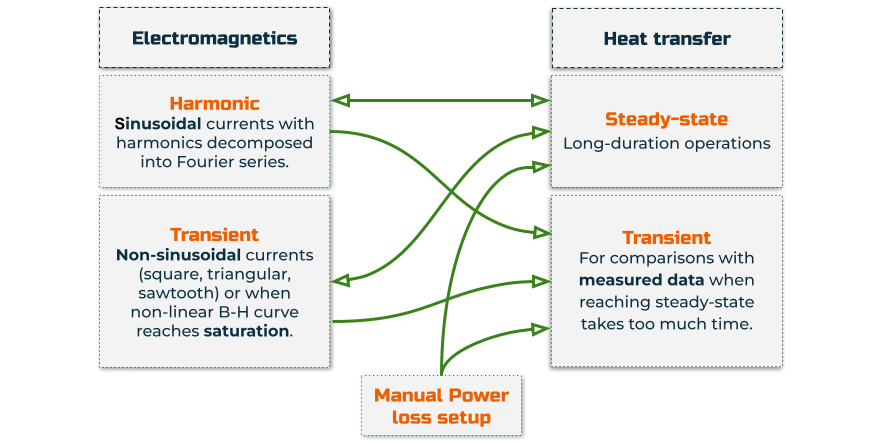
TRAFOLO uses an iterative coupling loop:
- Electromagnetics: Calculates the core and winding losses based on the applied excitation.
- Heat Transfer: Takes these mapped volumetric losses as heat sources and calculates the resulting temperature distribution.
- If temperature-dependent materials are used, the updated temperatures can be fed back into the EM solver to update resistances and core loss coefficients, repeating the cycle until convergence.
Common Numerical Models
To accurately capture the thermal behavior of a transformer or choke, TRAFOLO focuses heavily on heat conduction within solids, explicitly skipping Conjugate Heat Transfer (CHT) and Computational Fluid Dynamics (CFD).
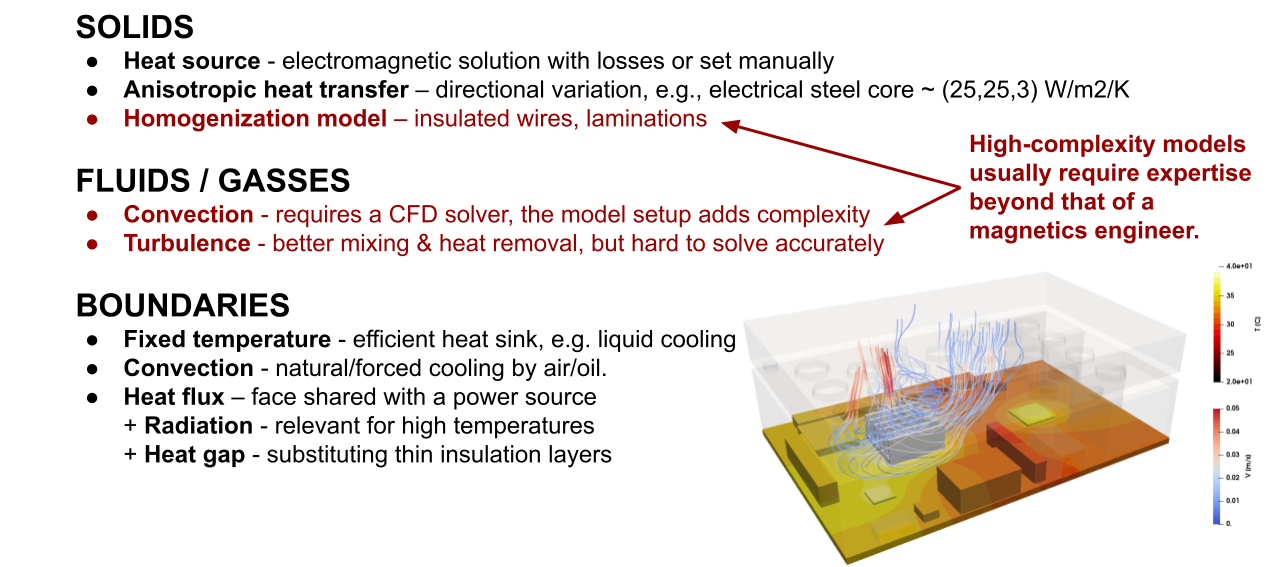
Heat Transfer Boundary Condition
As a fast and robust alternative to CFD, TRAFOLO approximates the cooling effects of surrounding fluids (air or oil) by applying convective boundary conditions exclusively to the external faces of the 3D geometry.
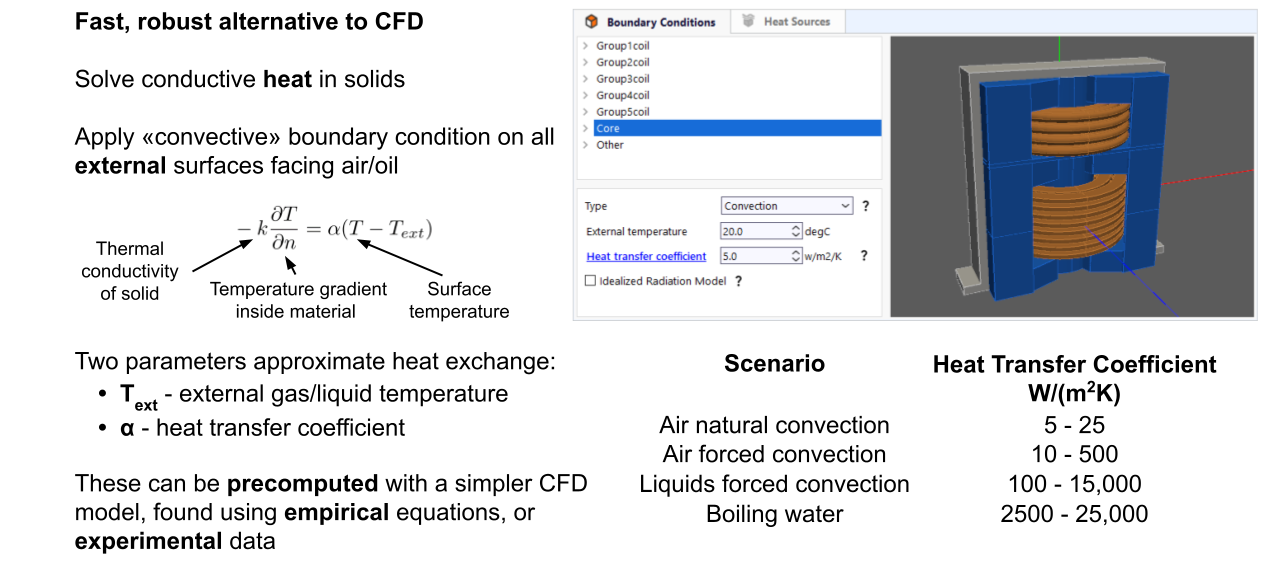
By defining just two parameters (α and Text), you can effectively simulate natural convection, forced air cooling, or liquid cold plates without the overhead of fluid meshing.
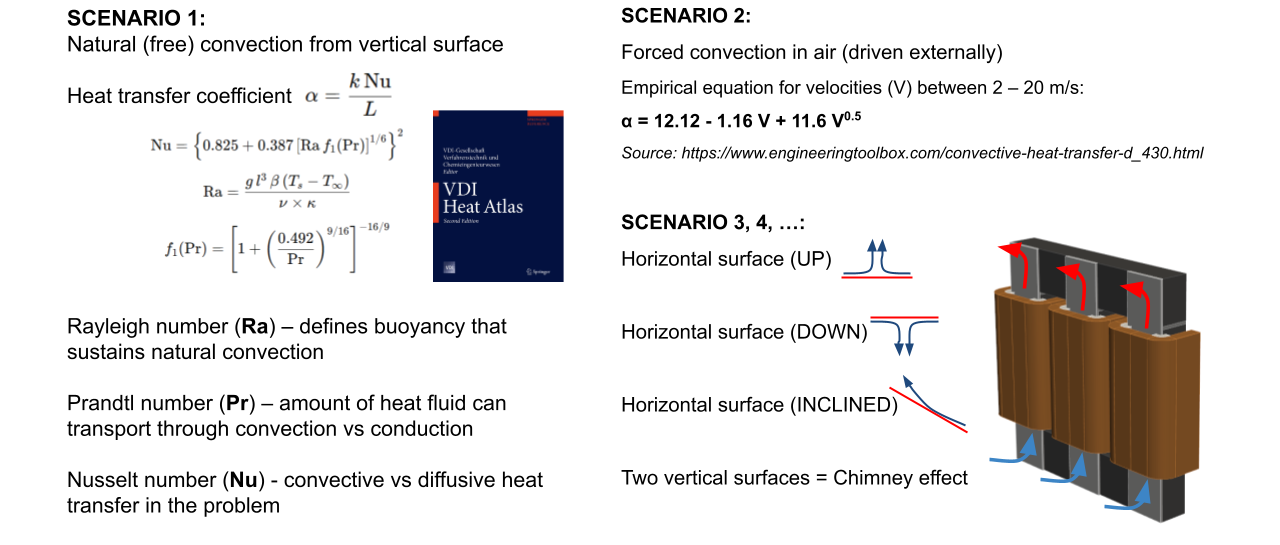
Estimating Heat Transfer Coefficients
If the ambient temperature (Text) and the heat transfer coefficient (α) are estimated correctly, this boundary condition method yields highly accurate thermal results. The primary challenge is that α is rarely a known constant; it changes based on geometry, fluid type, and flow velocity.
Grey Body Radiation Model
For high-temperature applications, thermal radiation becomes a non-negligible cooling factor. Heat is emitted from the component’s surfaces in the form of electromagnetic waves, governed by the Stefan-Boltzmann law:
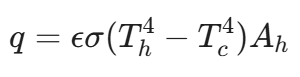
Where q is the heat transfer, ε is the emissivity of the surface, σ is the Stefan-Boltzmann constant, Th and Tc are the hot and cold absolute temperatures, and Ah is the surface area.
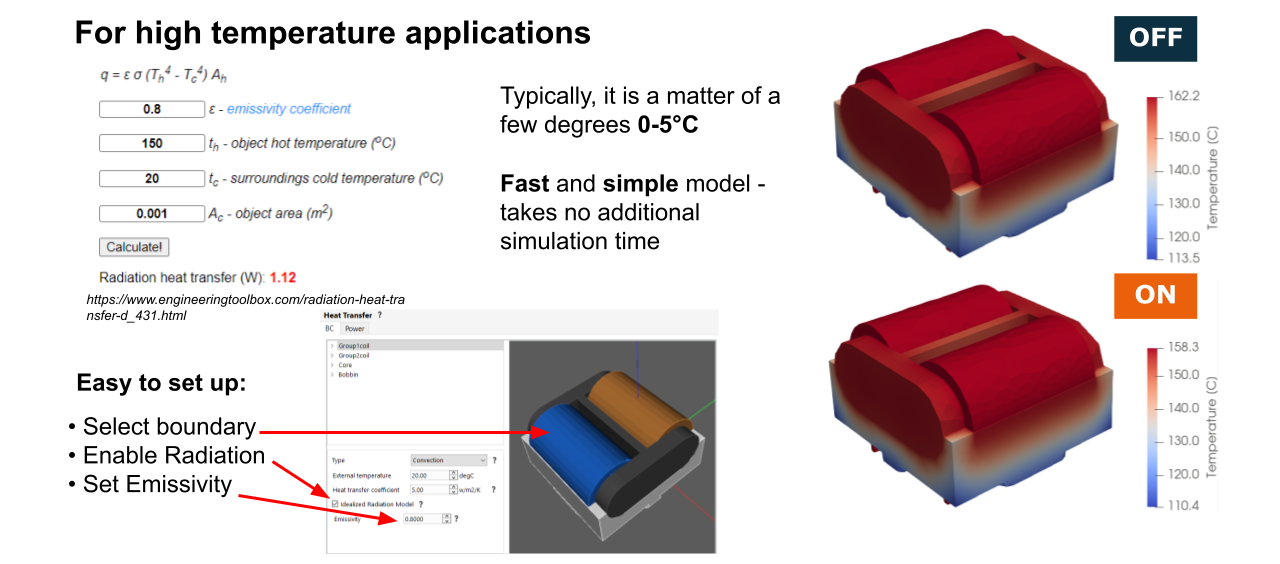
Idealized “Grey Body” radiation model is a very simplified, but fast model that assumes radiation escapes directly to the ambient environment without complex ray-tracing or internal reflections between component faces. It requires practically zero additional simulation time and no computational overhead.